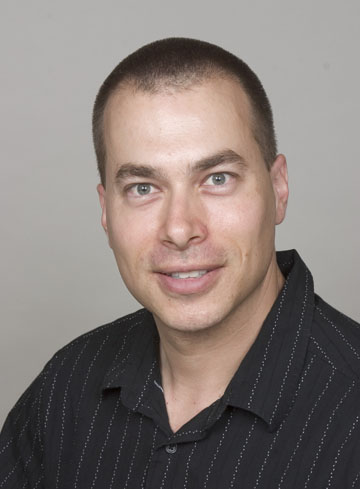
Ten new members of the regular faculty are beginning work in the life sciences at Brown this fall: David Badre in Cognitive and Linguistic Sciences; Karl T. Kelsey, Crystal Linkletter, Bess H. Marcus and Hernando Ombao in Community Health; Erika J. Edwards, Heather Leslie and Dov F. Sax in Ecology and Evolutionary Biology; Judith Bender in Molecular Biology, Cell Biology and Biochemistry; Elena Oancea in Molecular Pharmacology, Physiology and Biotechnology. Two other faculty members began at Brown last January: Gilad Barnea in Neuroscience and Carmen Marsit in Pathology and Laboratory Medicine.
See also new faculty in arts and humanities, social sciences and physical sciences.
Dov F. Sax
Assistant Professor of Ecology and Evolutionary Biology
Dov Sax thinks a lot about alien invasion and assisted migration, wondering how non-native species and climate change impact native biodiversity. "The whole concept of what native is changes when you start changing climate," he says. "We have to evaluate, and ask, do we change policy?"
What does he mean? Say the climate in Southern California is changing and a toad born and bred in Los Angeles would be better off in the cooler climes of San Francisco. For the toad, the options are few: Evolve fast or become extinct. Or, should humans assist in the relocation? What impact does that have on the toads already living in the Bay Area - and do they have to be moved as well? Can we use these theories to help stop extinctions in the wake of global climate change?
To help answer these questions, Sax takes a macroecological view, looking at data sets. He's examined 40 different distinct island groups, stepped back, and looked at the overall patterns of extinction. Sax asks, "How long does the process of extinction take? ... You can't predict what any one gas molecule is going to do, but you can predict what the whole set is going to do. There's a lot of value in looking at systems or sets of species. I might look at hundreds of species at once."
Sax arrives at Brown from the University of Georgia's Institute of Ecology. He did his postdoctoral work at the University of California-Santa Barbara and was awarded his Ph.D. at the University of New Mexico. The biologist is the co-founder of the International Biogeography Society, serving now asa member of its governing board. He has written two books, and six book chapters, most starting with the title "Species Invasions," and he's had some surprises along the way. "Generally, it is thought biodiversity is declining," he says. "It is on a global scale, but in some cases at a regional scale biodiversity is actually increasing."
Sax joins Brown as an assistant professor in the Department of Ecology and Evolutionary Biology, with a joint appointment in the Center for Environmental Studies.